Anna Newell
One of the great joys of my working life is mentoring other artists who are interested in working with my extraordinary audiences.
So I’m delighted to host this guest blog by my mentee, April Bracken….
My name is April Bracken, and I am a neurodivergent artist based in Dublin. In 2024, I was awarded the Arts Council’s Young People, Children and Education bursary to develop my practice as an artist exploring how to create work for children with additional needs. Anna acted as my project mentor, providing me with fantastic guidance throughout the bursary. A key aspect of the bursary was an artistic residency, which took place in St. Michael’s House Special School Ballymun. I collaborated with dance artist Brona Jackson for this residency, who is also passionate about creating work for this audience. Our exploration began with the theme of birds, investigating how they brave the elements to create cosy, sturdy homes from what they gather.
The residency was my first time working with young people with complex needs. Anna offered me lots of valuable advice prior to beginning the residency, including:
● Creating a staff information sheet to leave in all the classrooms when you first introduce yourself, explaining who you are and what your objectives are for the residency. In this instance, we wished to communicate that we were exploring how to make work for this audience, and that all responses from the young people (positive, negative or indifferent!) were welcome and valuable. With this in mind, we invited the staff to help us in creating a quiet and calm atmosphere
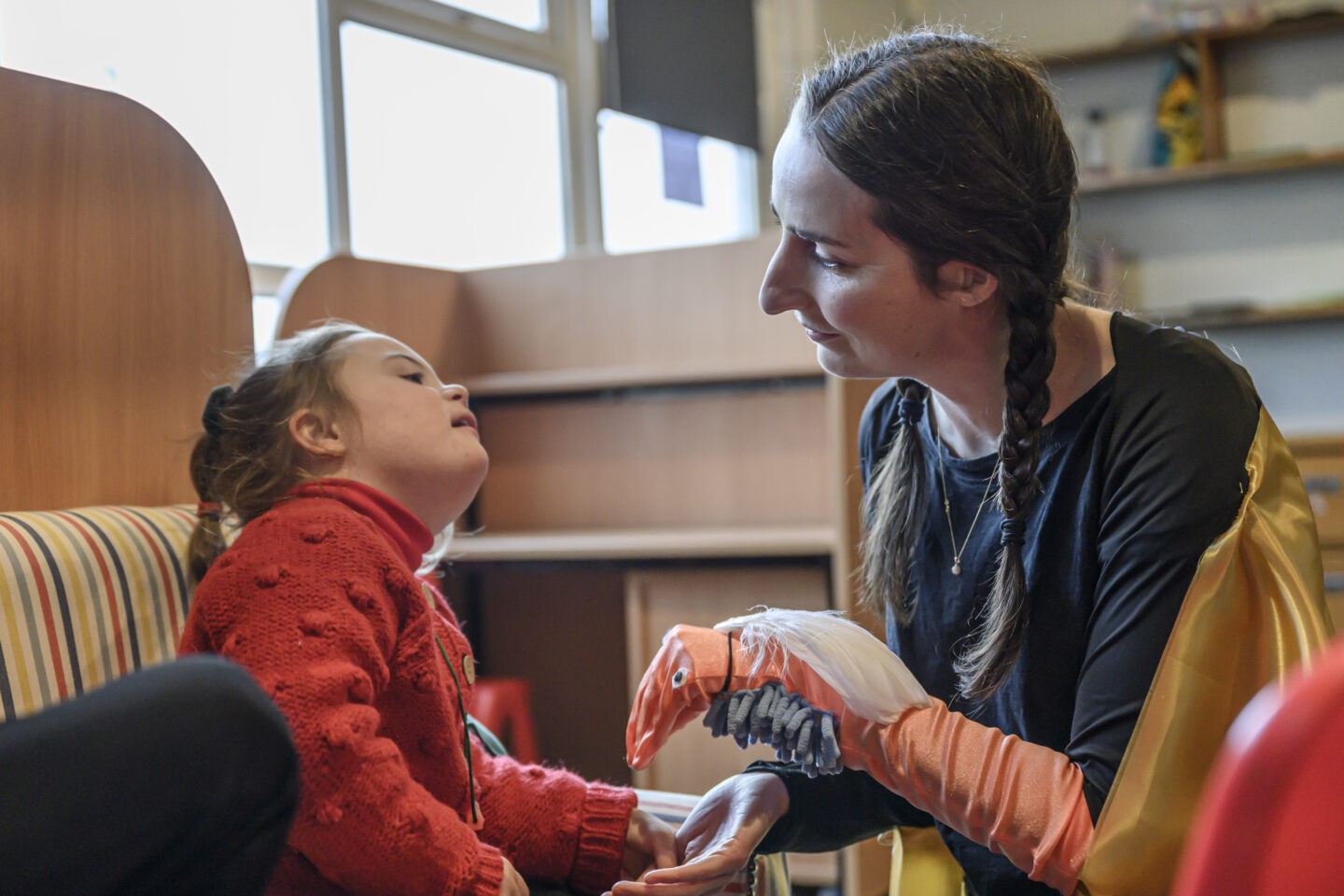
● Having 5-6 creative offers ready that reside in your chosen thematic world, that are exciting to you and that you think will be interesting for the young people you are working with. One of our offers was an orange glove with sewn eyes, feather plumage and a textured underbelly that we explored as a bird puppet
● Avoiding the impulse (prompted by nerves!) to have every aspect of the work decided in advance, as the young people are our creative consultants and their responses should decide the direction that the work will go
● Being open, curious and responsive to each young person, meeting them where they are and aiming to ensure that they always have agency in your interactions. Sometimes a young person didn’t want to interact with us or our offers. We would respect their decision and gently attempt to connect with them the next time we met
● Keeping true to the objectives of the bursary. I was there to learn how I might approach making work for this audience, and not to have a show ready by the end of the process. This meant taking creative risks, experimenting with combining our offers in various ways, and being open to unexpected directions that the work took us
The residency was incredibly beneficial to my practice, as I had the opportunity to delve into creating work for young people with complex needs with the young people themselves being at the centre of the process. We visited every classroom each week, trying out our creative offers with children of varied ages, energies and comfort with our presence. We quickly learned that each offer needed to be highly adaptable depending on how the young person wished to interact with us. The work developed in response to how the young people reacted to us and our offers, with Brona and I reflecting together on what happened after each visit and planning our next steps based on what we had experienced. We each had magic moments in which we felt connected with a young person, the sensory stimulus being a conduit for that connection. Many of the staff responded positively to the residency, noting:
The work you and Brona did with our students was perfectly tailored to their needs, and they thoroughly enjoyed every moment of your sessions”
(The young people) enjoyed freedom to move and enjoyed being able to participate at their own pace
(The young people) felt they could relate to the adults who were leading the session”
(The sessions were) deeply satisfying and calming. Students very positive about seeing April and Brona on timetable”
There were also challenges to the residency, most notably the school undergoing intensive construction during our time there and therefore space/quieter areas being quite limited. This is particularly tricky when, as a neurodivergent artist, sensory overwhelm in a busy school environment becomes an issue. Luckily The Axis, Ballymun, kindly provided Brona and I with weekly rehearsal space where we could debrief and plan our classroom visits. During the residency, I also had to adjust my expectations and avoid “chasing reactions” from the young people, as it was tempting to measure the success of our visits based on the size of the students’ responses to us. Although seeking positive responses may be a natural inclination (particularly for performers!), it fails to honour how some young people experience the world and becomes about the artist’s need for validation rather than the young person themselves (inclusive UK theatre company Oily Cart describe this really well in their report ‘Being With’ In Sensory Theatre).
Overall, the residency held so many rich opportunities for learning, from the staff, from my collaborator Brona, and of course from the young people we had the pleasure of getting to know during our time there.
Another key aspect of this bursary was observing and learning from those who are currently creating high quality arts experiences for this audience. Since 2023, Anna has given me the opportunity to observe her shows created for children with complex needs, including Sing Me To The Sea, Sweet Dreams Are Made Of This and Up In The Clouds. Seeing Anna’s work has enriched our mentoring conversations, as we have a shared reference when discussing various aspects of the work.
Observing international work can be challenging as a neurodivergent artist with caring responsibilities, as travelling abroad can be difficult in terms of navigating unfamiliar experiences and organising suitable childcare. Fortunately I was supported by Baboró’s Breaking Ground bursary to attend their 2024 Galway festival to observe Sweden-based choreographer Dalija Thelander’s Fields of Tender. I followed up this visit with a fruitful online discussion with Dalija. I have also had conversations with Hayley Earlam, an inclusive dance artist based in Scotland, and Christopher Davies, co-founder and artistic director of Bamboozle Theatre Company in England. While I haven’t seen Hayley and Christopher’s shows in person, they both gave me access to performance recordings that informed my understanding of their approach to making this work. Learning more about the work of international artists has allowed me to gain insight into how varied the pathways can be to creating work for this audience, and a hybrid approach of Ireland-based in-person encounters and online conversations made the experience accessible for me.
I was delighted to have had the opportunity to explore creating work for young people with additional needs under the YPCE bursary, and I am looking forward to further developing my practice in this area, including growing a sustainable model of working as a neurodivergent artist. Many thanks to Anna for hosting this sharing of my experience and to the Arts Council for making it all possible!
Photos by Neil Harrison Photography